
Shopify store development
We launch and grow Shopify stores: customise the theme, connect shipping and payments, push orders into your CRM and set up tracking you can actually trust. Shopify is the shortest route to a stable store if you do not want to deal with hosting and you sell in more than one market.
When to choose Shopify
- You sell in several countries and currencies, or plan to
- You don’t want to deal with hosting, updates and security
- You need a quick launch and stability during sales peaks
- Your catalogue is standard: products with variants, collections, discounts
- Your team will manage products, orders and promotions in a friendly admin
When another platform fits better
- You need unusual pricing logic, configurators or B2B portals — WooCommerce is more flexible
- Keeping monthly subscription and app costs minimal is a priority
- The store is one part of a larger product with accounts and its own data
- You want the site and data physically on your own server
What Shopify is and why stores choose it
Shopify is a hosted e-commerce platform: you pay a subscription and the platform takes care of hosting, security, updates and speed under load. Themes are written in the Liquid templating language, extra features come from apps in the App Store, and product data can be extended with metafields. For an owner that means fewer technical risks and an admin the team can use from day one.
Limits worth knowing up front
- Checkout can only be changed as far as the platform allows; the deepest checkout customisation is reserved for Shopify Plus.
- Payments. Shopify Payments is not available in every country, and when you take payments through a third-party gateway Shopify may charge an extra transaction fee.
- Apps cost money and speed. Each one adds a monthly fee and its own scripts. A store with twenty apps is often slow and counts conversions several times.
- The URL structure is fixed: products always live under /products/, categories under /collections/. That is fine for SEO, but a migration needs a redirect map.
How we build on Shopify
We don’t install an app for every task. What can live in the theme goes into the theme; what Shopify can’t do goes onto a small separate back end.
Our supplement brand store shows this best. The standard checkout didn’t cover the brand’s home market, so we built a custom order flow on a serverless back end: local carrier branch and parcel locker selection, a local payment gateway, and every order sent straight to the CRM, the team’s Telegram and e-mail. In the theme: a metafield-driven product page (ingredients, dosage and benefits editable without code), a free gift with orders, promo codes via a pop-up, one-click purchase, reviews with an overall rating, Meta Pixel, dataLayer events and a Google product feed. For bulk changes we wrote an SEO field updater and a tool that migrates data between Shopify stores.
Tracking on Shopify deserves its own section
On Shopify it is easy to end up with three parallel analytics setups: GTM in the theme, the native Google and Meta apps, and custom pixels. In a tracking audit for one store we found the GTM container loading three times on every page, so ad tags fired three times. After our fix release each tag fires once. If your ad platforms and Shopify disagree on the numbers, start with analytics and tracking.
Shopify or another platform?
| Shopify | WooCommerce | BigCommerce | |
|---|---|---|---|
| Hosting and security | The platform | You or your developer | The platform |
| Monthly costs | Subscription + apps | Hosting, some plugins | Subscription |
| Flexibility | Medium | Highest | Medium, strong B2B features |
| Selling abroad | Very easy | Needs setup | Easy |
| App ecosystem | Largest | Large | Smaller |
What to check in your current store
- How many apps are installed, and which ones you still pay for but don’t use.
- How many times GTM and ad pixels load on a page.
- Whether Shopify orders match conversions in Google Ads and Meta.
- How fast a product page opens on a phone.
If any answer is “I don’t know”, that is a reason for a technical diagnostic.
Still comparing platforms? Read Shopify vs WooCommerce. If shoppers add products to the cart but do not pay, see abandoned carts: what actually works.
What we do on Shopify
Online store
A new store or growing an existing one: theme work, metafields, promotions, multiple languages, custom checkout flows.
from €2,000Learn moreAnalytics and tracking
GA4, GTM, server-side tagging via Stape, custom pixels without duplicates — so Shopify and ad numbers match.
from €500Learn moreCRM development
Orders and enquiries from Shopify into your CRM, with team notifications in Telegram.
from €2,000Learn moreGoogle Ads, Meta Ads and analytics
Google product feed, Meta Pixel and campaigns that learn from correct conversions.
from €400/moLearn moreTechnical audit and discovery
A theme and app diagnostic: what slows the store, what duplicates, what can go — with a video walkthrough.
from €300Learn moreWebsite support
Theme changes, new features, app updates and performance checks every month.
from €100/moLearn moreOur work on Shopify
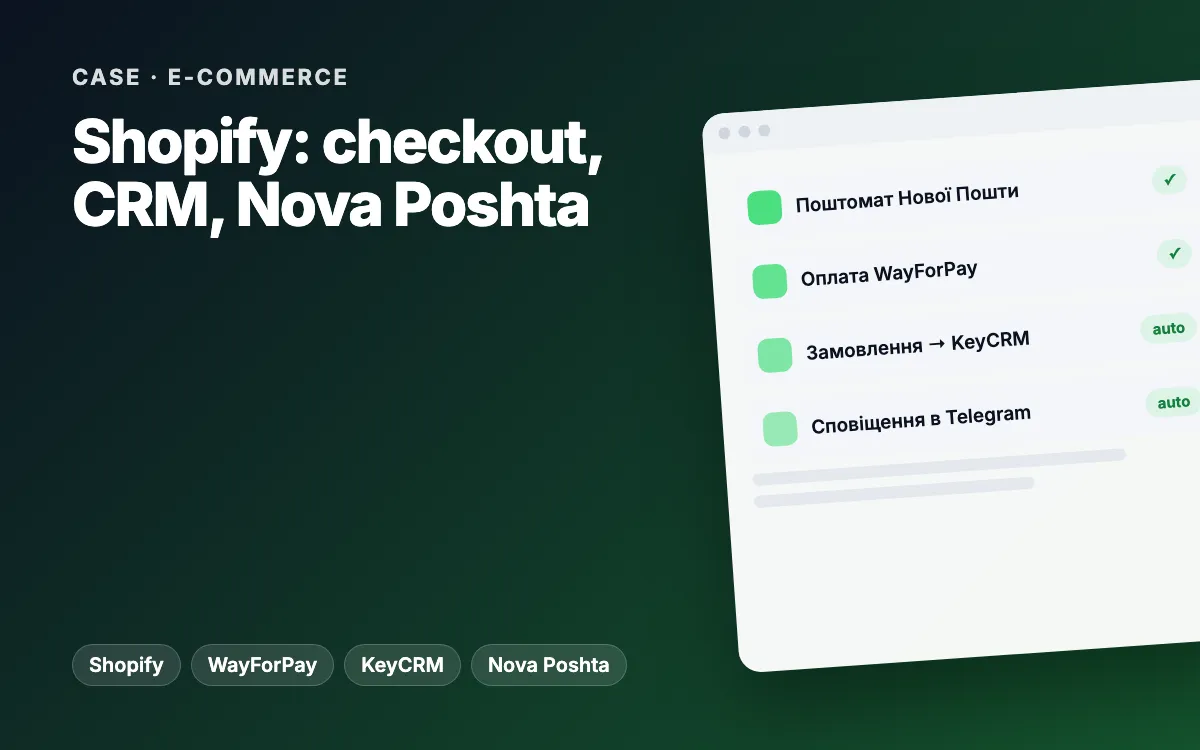 Client project · 2026 · Shopify · Node.js
Shopify store for a supplements brand
Custom checkout with Nova Poshta and WayForPay, orders into KeyCRM and Telegram, reviews, promo codes, English version.
Read the case study Shopify · GTM · Stape · GA4Tracking and attribution audit for an online store
Audit · 2026Found GTM loading three times and duplicate ad tags, shipped a fix release and a plan for orders without a source.
Read the case studyShopify store technical diagnostic
Audit · 2026Report on theme and app issues, a video walkthrough for the owner and a fix plan.
How much Shopify development costs
| Services | Price and timeline | |
|---|---|---|
| Online store | from €2,000 · from 45 days | Learn more |
| Analytics and tracking | from €500 · from 14 days | Learn more |
| CRM development | from €2,000 · from 45 days | Learn more |
| Google Ads, Meta Ads and analytics | from €400/mo · from 7 days | Learn more |
| Technical audit and discovery | from €300 · from 7 days | Learn more |
| Website support | from €100/mo · from 3 days | Learn more |
Starting prices are those of our services; we give an exact figure after a short brief.
Moving to Shopify and away from it
To Shopify come stores that are tired of managing hosting and plugins. We move products with variants, collections, pages, images and SEO fields, build a 301 redirect map from old URLs to the new /products/ and /collections/ paths, and check after launch that Google sees the new pages. Data between two Shopify stores — for example when opening a new region — we move with our own migration tool.
Leaving Shopify makes sense when the subscription and apps cost more than they return, or when you need logic the platform won’t allow. Then we look at WooCommerce or, for B2B with large catalogues, BigCommerce.
Tell us what you sell and where — we will recommend a platform and price both options.
FAQ
How much does a Shopify store cost?
Store development starts at €2,000, with a timeline from 45 days. Shopify’s subscription and any paid apps are billed separately; we will tell you at the start which ones you actually need.
Do you build themes from scratch or customise existing ones?
Usually we start from a solid theme and customise it: sections, metafields, product pages. We write from scratch when the design differs too much from any ready theme.
Why is my Shopify store slow?
Most often because of apps: each one adds scripts to the page. A technical diagnostic shows what can be removed or replaced with theme code. Audits start at €300.
Can one Shopify store sell in several countries?
Yes. Shopify supports multiple languages, currencies and markets in one store. We have added an English version to a store that originally sold in one country.
Can you connect Shopify to our CRM?
Yes. We send orders and enquiries to the CRM and to team chats automatically — for example to KeyCRM and Telegram on the supplement store.
What does Shopify cost to run each month?
The subscription depends on your Shopify plan; on top come paid apps and, if you use a third-party payment gateway, a platform transaction fee. We help cut the app list by moving features into the theme.
Other platforms
WordPress & WooCommerce
Business sites, blogs and WooCommerce stores that you fully own.
Learn moreWebflow
Design-led sites and content portals your marketing team edits itself.
Learn moreSquarespace
A beautiful site for an expert or a brand that the owner runs alone.
Learn moreBigCommerce
Hosted stores for large catalogues and B2B selling.
Learn moreNext.js
Web platforms, dashboards and SaaS when a CMS is too tight.
Learn moreGet a Shopify store audit
We check your site the way customers and Google see it and send a short report with specific action points — no strings attached.
- Speed and mobile experience
- Title, description, H1, schema.org, sitemap
- Forms, click-to-call, online booking
- Analytics, Pixel and ads
- HTTPS and security headers
Tell us about your project
We reply within one business day. Or message us on your favourite messenger.
- Reply within one business day
- Free consultation and estimate
- NDA on request, before we start