
Telegram and WhatsApp bots, AI assistant for business
The bot answers common questions, takes enquiries and bookings, and passes on only what needs a human.
Sound familiar?
- The same questions every day
- Messages at night and on weekends go unanswered
- Enquiries from messengers get lost
What is included
- Flows for your typical requests
- Enquiries and bookings
- AI answers based on your own materials
- Hand-off of complex questions to a manager
- CRM or spreadsheet integration
A business chatbot is a bot in WhatsApp, Telegram or on your website that answers common questions around the clock, takes enquiries and bookings, and passes to a manager only what needs a human. It suits businesses that get the same questions every day: service companies, clinics, schools, shops. Pricing starts from €500, with a timeline from 14 days.
Who needs a bot and what it handles
- The same questions every day: prices, opening hours, address, delivery, “is it in stock?”. The bot answers instantly and your team stays focused.
- Messages at night and on weekends go unanswered, and the customer goes to whoever replied first.
- Enquiries from messengers get lost in managers’ personal chats.
- Bookings by chat take hours — the bot offers free slots and records the booking.
- Lead qualification: the bot asks a few clarifying questions, so the manager receives a clear request.
More on what slow replies cost you is on our page about slow responses to customers, and on lost enquiries — leads get lost.
Scripted bot or AI assistant
| Criterion | Scripted bot (buttons and menus) | AI assistant |
|---|---|---|
| How it answers | Through predefined flows | In its own words, based on your materials |
| Best for | Few request types, a clear process | Many different questions, a large price list or knowledge base |
| Predictability | Full: it only says what is scripted | High, if sources are restricted and there is a human hand-off |
| Maintenance | Update the flows when things change | Update the materials it answers from |
A mix often works best: buttons for enquiries and bookings, AI for open questions. Read more in AI agents for business and on our AI services page.
Stages and timeline
- Collecting typical requests. We go through real conversations and the most frequent questions, and decide what the bot handles alone and what it passes to a person.
- Flows and copy. We write the dialogues in your tone of voice and agree them with you.
- Build and integrations. The bot, leads into your CRM or a spreadsheet, team notifications and, if needed, calendar bookings.
- Testing. We run real questions through it and check that it does not make things up and calls a human in time.
- Launch and tuning. In the first weeks we review real conversations and refine the flows.
A bot with typical flows takes from 14 days. An AI assistant on a large knowledge base or several channels takes longer.
What affects the price
| Factor | Effect on price and timeline |
|---|---|
| Base bot: flows, lead capture, manager hand-off | from €500, from 14 days |
| AI answers based on your materials | Preparing the knowledge base and testing answers |
| Number of channels (WhatsApp, Telegram, website) | Each channel has its own limits and setup |
| CRM, calendar or payment integration | Each integration adds work |
| Several languages | Translated flows and checked answers |
Third-party costs may come on top of our price: WhatsApp Business Platform messaging fees or AI model usage. We name them up front.
Tools and platforms
WhatsApp Business Platform, Telegram Bot API, website chat widgets; AI models restricted to your own materials; API integrations with CRMs, Google Sheets and calendars. We write bots in Node.js/TypeScript or Python and deploy them on your server or in the cloud. If you only need appointments, compare with our online booking service.
An example from our work
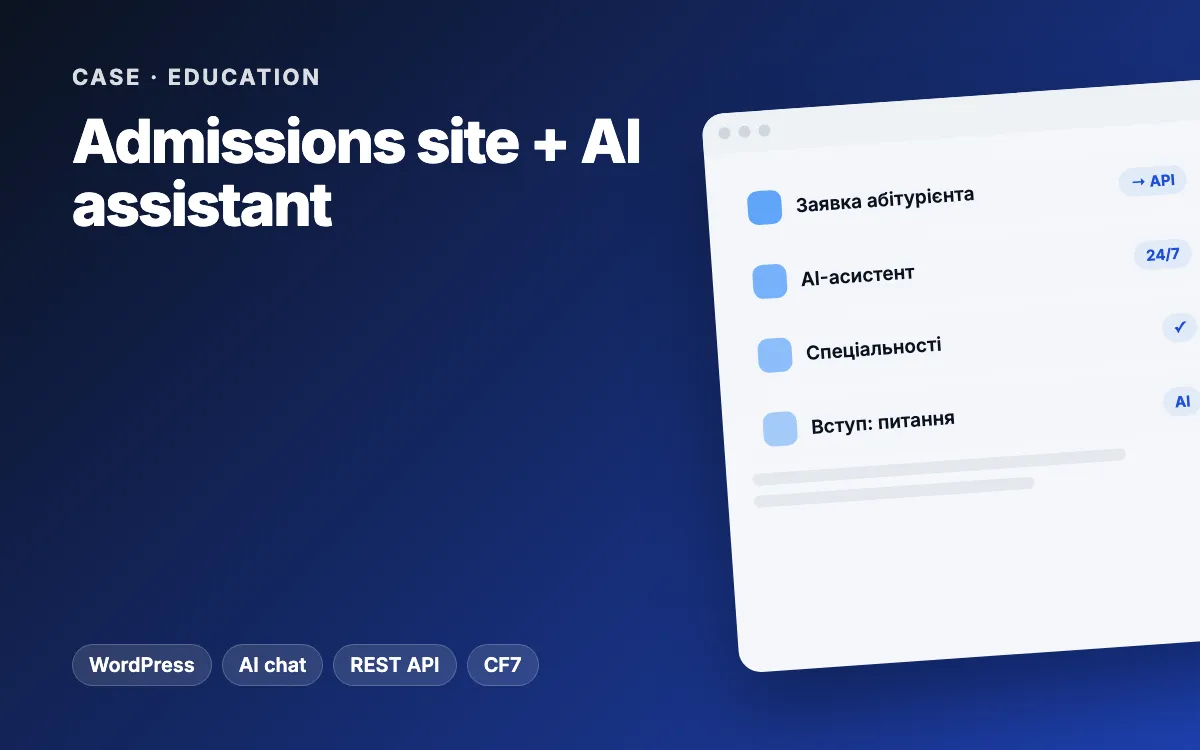
For a university admissions website we built an AI assistant widget that answers applicants’ questions about admission and programmes, while form enquiries go straight into the learning platform. The admissions office gets fewer repeated questions. Details are in the university admissions case study. In a Shopify supplement store, orders and enquiries arrive automatically in the team’s Telegram and the CRM. Our own website also sends every enquiry to Telegram.
What to prepare before we start
- 20–30 real customer questions from recent conversations — they are the backbone of the flows.
- Current prices, terms and hours, plus the answers your team gives to the most common objections.
- Hand-off rules: which questions the bot never handles alone — complaints, refunds, individual discounts.
- Where leads go: CRM, spreadsheet or team chat, and who is responsible for them in and out of hours.
What a bot should not do
A good bot does not pretend to be a person, does not promise anything outside your terms and does not trap customers in endless menus. Every step needs a “talk to a manager” option. An AI assistant does not invent prices or deadlines: if the answer is not in your materials, it says so and passes the conversation on. And a bot does not replace a fast team response — it buys the team time by recording the request, collecting details and giving a realistic reply time.
What to measure after launch
- Share of conversations closed without a manager — how much routine the bot really took over.
- Out-of-hours enquiries — the ones that used to get lost.
- Time to first reply and time to a manager’s reply after hand-off.
- Questions the bot could not answer — a ready-made list for updating your materials.
- Where customers drop out — a sign that a flow is too long or unclear.
How to choose a contractor
- Is there a human hand-off, and can the manager see the conversation history?
- Where does the AI get its answers, and what does it do when it does not know?
- Who owns the bot, tokens and data — they should be in your name.
- Who updates the flows when prices or services change?
- Are third-party costs included for messengers and AI models?
If messenger enquiries are already slipping away, start with where lost leads go and how to stop it: a bot closes only some of those gaps, and rules and a CRM close the rest.
Want a bot that handles routine questions and never loses a lead? Tell us what customers ask most often and we will suggest a flow and a price.
Problems this solves
Enquiries get lost
Enquiries are scattered across Instagram, Telegram, email and phone — and some simply vanish.
How to fix itCustomers wait too long
Someone messages in the evening or at the weekend and hears back the next day — after buying elsewhere.
How to fix itSelling only on Instagram
Every order comes through DMs, and you answer “how much?” by hand every time.
How to fix itAppointments booked by hand
Your receptionist spends all day on calls and messages, and the schedule still has clashes.
How to fix itFAQ
Will the bot say something wrong?
The AI assistant answers only from your materials and hands anything it is unsure about to a human.
How much does a business chatbot cost?
From €500 for a bot with flows for your typical requests, lead capture and hand-off to a manager. AI answers based on your materials, several messengers and CRM integration add scope.
Telegram or WhatsApp — which one?
Wherever your customers already write. A Telegram bot is simpler and cheaper to launch; WhatsApp for business runs on Meta’s official API with its own rules and per-message pricing. We often build one flow for both channels.
How long does it take to build a bot?
From 14 days for a bot with typical flows and lead capture. An AI assistant, several languages and integrations add time — the timeline is fixed in the quote.
Will I see every conversation?
Yes. Leads and conversations go to your CRM, a spreadsheet or a team chat, and the bot hands complex questions to a manager with the full history.
Articles on the topic
How to automate website leads: instant alerts, CRM and follow-up reminders
Automate website leads: instant team alerts, automatic CRM records with the ad source, a confirmation to the customer and reminders when nobody replies.
Read Sales Where do the leads go? · 7 min readLost leads: where enquiries from your website, messengers and calls disappear, and how to stop it
Where leads from your website, Instagram, WhatsApp and phone calls go missing: 8 common leaks, a 20-minute test and how to keep every enquiry in one place.
Read Websites Instagram → your own site · 7 min readSelling only on Instagram: why your business needs its own website and how to switch without losing customers
Selling only through Instagram? What you risk without your own website, what a site adds, and how to move orders to it step by step without losing customers.
ReadOther services
New website or redesign
A modern, fast website that makes it easy for customers to understand your offer and get in touch — on mobile too.
from €1,200Learn moreOnline store
A store that is easy to buy from and easy to run: catalogue, payments, delivery, e-mail marketing.
from €2,000Learn moreCRM development
A CRM that works the way your team sells: enquiries from the website and messengers, pipeline, tasks, reminders and reports — without clutter or per-seat licences.
from €2,000Learn moreTell us about your project
We reply within one business day. Or message us on your favourite messenger.
- Reply within one business day
- Free consultation and estimate
- NDA on request, before we start