
Slow response to customers: how to reply fast, 24/7
Customers wait too long when the team physically can’t keep up: messages arrive after hours, most questions repeat, and every answer needs looking something up. The fix is not another hire, but taking routine answers off people and speeding up the first reply.
Sound familiar? Tick what applies
Tick the points you recognise.
Customers now message several companies at once and choose whoever replies first and clearly. While you’re getting round to an answer, they already have a price from a competitor. You pay in full for ads and traffic, then hand part of your ready-to-buy customers to whoever picks up faster. A slow reply also cancels out everything else: a good website and a strong offer don’t help if the customer leaves before you answer.
Customers wait too long: why it happens
- 01
Nobody replies after hours
The team works nine to six, but customers write in the evening, at night and at weekends, exactly when they have time to think about buying. How to check: work out what share of last month’s messages arrived after 6 pm or at weekends.
- 02
Repetitive questions eat the day
Most messages are routine: how much, is it in stock, how do I book. Staff spend hours on these while complex requests wait. How to check: write down the last 30 customer questions and group them. Usually a handful of topics cover most of them.
- 03
Every answer needs looking up
Prices are in one file, the schedule in another, stock in somebody’s head. Each reply means checking with colleagues first. How to check: time how long a new team member takes to answer a price question.
- 04
No ready-made replies
Everyone writes each answer from scratch, in their own way and with different detail. It’s slow, and customers get different information. How to check: ask two people to answer the same question and compare.
- 05
Messages are scattered across channels
Instagram, WhatsApp, email, the website form: each has to be opened separately, so some messages are noticed late. How to check: how many apps do you open to see all new enquiries?
- 06
No self-service on the website
Customers can’t see a price, a free slot or an order status themselves, so they write and wait. How to check: which routine questions could a calculator, online booking or an FAQ page answer?
- 07
Nobody sees how long customers wait
Response time isn’t measured, so the problem stays invisible until customers start disappearing. How to check: take your last 20 conversations and note the minutes between the first message and your reply.
How we fix it
- 1
Build an answer base
Together we put prices, terms, hours and answers to common questions in one place. It serves both the team and the bot.
- 2
An instant first reply
A chatbot in messengers and on your website greets the customer, answers common questions and collects contact details at any hour.
- 3
An AI assistant trained on your data
We train AI on your prices, services and rules: it answers naturally and to the point, and hands complex questions to a person.
- 4
Booking and ordering without staff
Customers can pick a time slot, place a request or get a quote themselves, with no waiting.
- 5
A clean handover to a human
Automation passes the conversation to a manager with the full history, flags unanswered messages and shows how long the customer waited.
Services that solve it
AI services: business 24/7
AI agents that work while you sleep: they answer customers, qualify leads, draft proposals, find new clients and report to you in the morning. You only approve what matters.
from €1,000Learn moreTelegram / WhatsApp bot, AI assistant
The bot answers common questions, takes enquiries and bookings, and passes on only what needs a human.
from €500Learn moreBusiness process automation
We remove manual routine: data flows between your website, CRM, payments, inventory, accounting and messengers on its own, so your team works with customers instead of copying spreadsheets.
from €800Learn moreRelated case studies
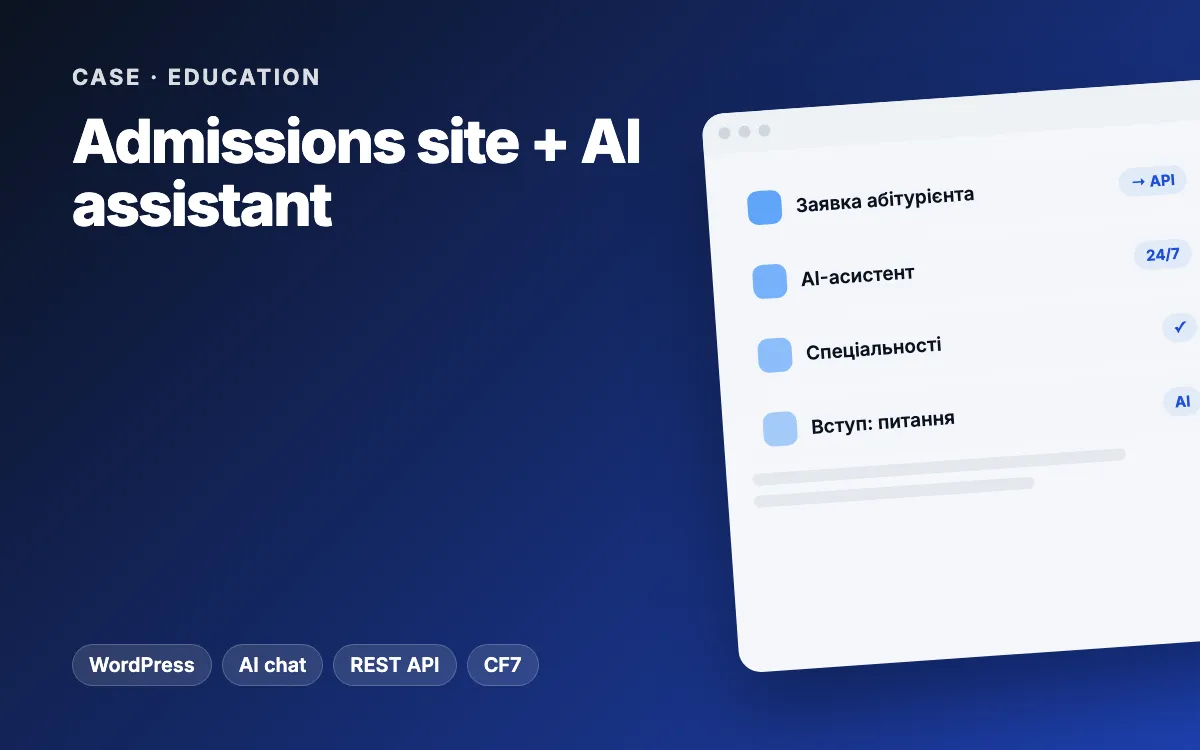
University admissions site with an AI assistant and enquiries sent straight to the platform
An applicant’s form and documents become a record in the learning platform’s “Applicants” module instantly, and an AI assistant that answers only from a vetted knowledge base handles common admissions questions.
Learn moreDigital AI university: learning platform with an AI assistant and an applicants CRM
The university has its own platform where courses, tests, timetables, internships, support and applicant enquiries live in one system, while AI drafts courses and answers students from each subject’s material.
Learn moreArticles on the topic
AI agents for business: how to run 24/7 without hiring more people
What AI agents are, how they differ from chatbots, which business tasks they handle today, what implementation costs and how to keep the AI under control.
Read Automation Lead → CRM → alert · 7 min readHow to automate website leads: instant alerts, CRM and follow-up reminders
Automate website leads: instant team alerts, automatic CRM records with the ad source, a confirmation to the customer and reminders when nobody replies.
Read Automation Less routine · 7 min readRoutine eats your day: 10 processes a small business should automate first
Which processes a small business should automate first — leads, bookings, documents, orders, reports — and how to calculate the hours automation frees up.
ReadFAQ
How do I measure my response time?
Take the last 20 conversations in each channel and note the time from the customer’s first message to your reply. Count after-hours messages separately. That is enough to see the scale.
Won’t a bot put customers off?
What puts people off is silence and clumsy bots that don’t understand the question. A good bot is upfront about being a bot, gives a useful answer quickly and hands over to a person when needed.
Could the AI say something it shouldn’t?
The AI assistant works within your data and rules: what it may promise, which prices to quote, when to call in a manager. Before launch we test it on real questions from your customers.
What can I do without any development?
Prepare reply templates, set an after-hours auto-reply with your hours and a website link, and add starting prices and an FAQ to the site. That alone removes some repeat questions.
How much does it cost?
A chatbot starts from €500, AI solutions from €1000, process automation from €800. The price depends on the number of channels and which systems need to be integrated.
Other problems we solve
Traffic, but no enquiries
People visit, look around and leave — no call, no message, no form.
How to fix itEnquiries get lost
Enquiries are scattered across Instagram, Telegram, email and phone — and some simply vanish.
How to fix itCustomers don’t come back
Someone buys once — and you never hear from them again.
How to fix itAds keep getting pricier
Your ad budget keeps growing, but the same money brings fewer enquiries.
How to fix itUnknown lead source
Money goes into several channels, but nobody can say which one brings the customers who pay.
How to fix itNot showing up on Google
Competitors appear in search and on Maps, while customers simply can’t find you.
How to fix itTell us about your project
We reply within one business day. Or message us on your favourite messenger.
- Reply within one business day
- Free consultation and estimate
- NDA on request, before we start