
Customers don’t come back: how to build repeat sales
Customers rarely fail to come back because of poor quality. Usually nobody works with them after payment: there’s no base with purchase history, no reminder at the right moment and no list of people who stopped buying. Repeat sales are a process you can set up.
Sound familiar? Tick what applies
Tick the points you recognise.
Winning a new customer almost always costs more than selling again to someone who already knows and trusts you. Without repeat sales, the business starts from zero every month: all revenue depends on advertising, and every rise in traffic costs hits profit directly. Customers who could have bought for years simply forget you and go to whoever reminded them first.
Customers don’t come back: why it happens
- 01
No base with history
Contacts are scattered across phones, chats and receipts. You can’t see who bought what, when and for how much, so there’s no one to come back to. How to check: try to list, in five minutes, the customers who bought twice or more in the last year.
- 02
The customer is forgotten after payment
All attention goes to acquisition. After the sale there’s no planned contact: no thank-you, no check-in, no tip or offer. How to check: what does a customer get from you a week and a month after buying? If nothing, you’ve found the cause.
- 03
Reminders ignore the buying cycle
Every product has a natural rhythm: supplies run out, services need repeating, seasons change. Miss the moment and the customer buys wherever they happen to be. How to check: work out when your typical customer should buy again.
- 04
The same message for everyone
One email for someone who bought yesterday and someone who hasn’t been seen in a year is just noise. People unsubscribe or stop reading. How to check: look at open and unsubscribe rates in your last campaigns.
- 05
No reason to return
No loyalty scheme, no personal offer, nothing new worth mentioning. The customer is happy but has no reason to choose you again right now. How to check: what can you offer a regular customer that a new one doesn’t get?
- 06
The after-sale experience disappoints
A late delivery, a painful return, an unanswered question, and the customer decides not to risk it again. How to check: ask your last ten customers for feedback and whether they would buy again.
- 07
Nobody works with lapsed customers
There’s no list of people who stopped buying and no process to win them back. They leave quietly. How to check: how many customers bought last year but not this year?
How we fix it
- 1
Build a customer base in a CRM
We move contacts and purchase history into one place and segment them: new, regular, and those who haven’t bought in a while.
- 2
Plan post-purchase touchpoints
We set up scenarios: a thank-you, a review request, a useful tip, a reminder when it’s time to buy again.
- 3
Automate reactivation
The system spots customers who haven’t bought for a while and triggers a personal message or a task for a manager.
- 4
Personalise with AI
AI helps match offers and wording to each customer’s history, so reminders feel relevant rather than like spam.
- 5
Measure repeat purchase rate
We add CRM metrics: how many customers bought again, after how long and after which reminder. You see which scenarios work.
Services that solve it
CRM development
A CRM that works the way your team sells: enquiries from the website and messengers, pipeline, tasks, reminders and reports — without clutter or per-seat licences.
from €2,000Learn moreBusiness process automation
We remove manual routine: data flows between your website, CRM, payments, inventory, accounting and messengers on its own, so your team works with customers instead of copying spreadsheets.
from €800Learn moreAI services: business 24/7
AI agents that work while you sleep: they answer customers, qualify leads, draft proposals, find new clients and report to you in the morning. You only approve what matters.
from €1,000Learn moreRelated case studies
Digital AI university: learning platform with an AI assistant and an applicants CRM
The university has its own platform where courses, tests, timetables, internships, support and applicant enquiries live in one system, while AI drafts courses and answers students from each subject’s material.
Learn more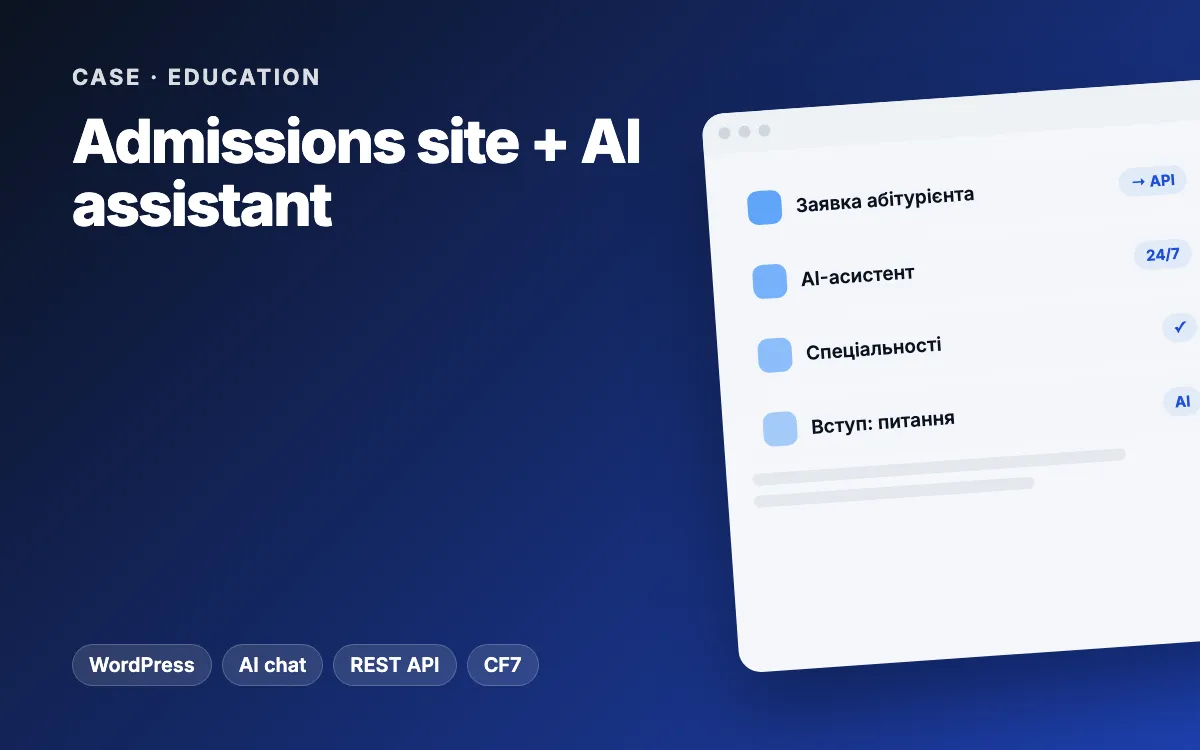
University admissions site with an AI assistant and enquiries sent straight to the platform
An applicant’s form and documents become a record in the learning platform’s “Applicants” module instantly, and an AI assistant that answers only from a vetted knowledge base handles common admissions questions.
Learn moreArticles on the topic
Routine eats your day: 10 processes a small business should automate first
Which processes a small business should automate first — leads, bookings, documents, orders, reports — and how to calculate the hours automation frees up.
Read CRM Custom or ready-made CRM? · 7 min readCustom CRM vs off-the-shelf: how small businesses should choose
Off-the-shelf or custom CRM? When HubSpot or Pipedrive is enough, when a custom CRM pays off, what it costs and what small businesses should automate first.
Read Automation Lead → CRM → alert · 7 min readHow to automate website leads: instant alerts, CRM and follow-up reminders
Automate website leads: instant team alerts, automatic CRM records with the ad source, a confirmation to the customer and reminders when nobody replies.
ReadFAQ
How do I work out my repeat purchase rate?
Export a year of orders from your till, store or spreadsheet, group them by phone or email and count how many customers bought more than once. Even a rough figure shows whether there is a problem.
Won’t customers see this as spam?
Spam is messages with no reason that are identical for everyone. A reminder tied to a real purchase and need usually comes across as good service. We set frequency and channels so you don’t become a nuisance.
We have little customer data. Where do we start?
With what you already have: contacts, chats, website or till orders. We move them into a CRM and from then on history is collected automatically. Useful segments appear within a few months.
Which channel works best for reminders?
The one where the customer already talks to you: email, a messenger or SMS. The reason and the timing matter more than the channel: a reminder should be about a specific need, not “we have discounts”.
How much does it cost?
CRM implementation starts from €2000, automation scenarios from €800, AI solutions from €1000. You can start with the base and simple reminders and add personalisation later.
Other problems we solve
Traffic, but no enquiries
People visit, look around and leave — no call, no message, no form.
How to fix itEnquiries get lost
Enquiries are scattered across Instagram, Telegram, email and phone — and some simply vanish.
How to fix itCustomers wait too long
Someone messages in the evening or at the weekend and hears back the next day — after buying elsewhere.
How to fix itAds keep getting pricier
Your ad budget keeps growing, but the same money brings fewer enquiries.
How to fix itUnknown lead source
Money goes into several channels, but nobody can say which one brings the customers who pay.
How to fix itNot showing up on Google
Competitors appear in search and on Maps, while customers simply can’t find you.
How to fix itTell us about your project
We reply within one business day. Or message us on your favourite messenger.
- Reply within one business day
- Free consultation and estimate
- NDA on request, before we start